See what we’re doing

Our Current Portfolio

Animal Life Sciences has licensed multiple drug technologies developed at the MD Anderson Cancer Center for the following diseases in animals:

  1. 1

    Advanced chemotherapies for the treatment of leukemias and brain tumors

  2. 2

    Cell signaling modulators and inhibitors of glycolysis for the treatment of a wide range of tumors

  3. 3

    Topical treatments for a wide range of cancerous and noncancerous inflammatory skin conditions

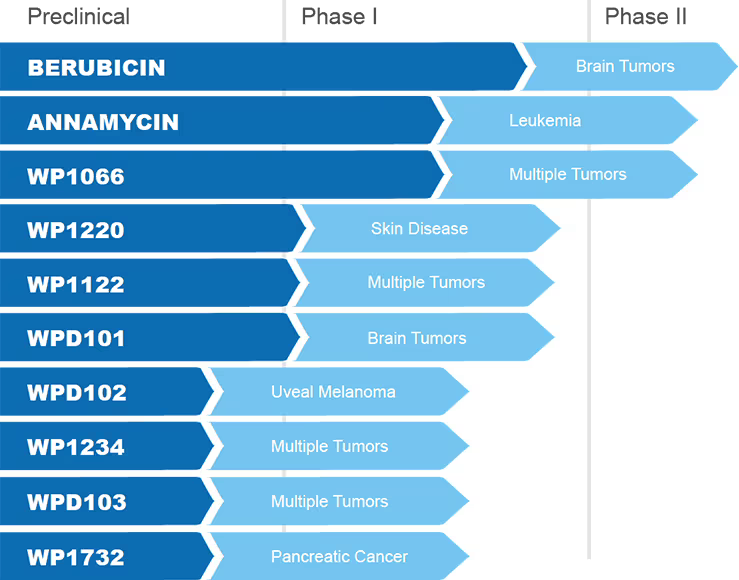
Our drug pipeline

Current Stages of Development and Testing

Pipeline chart. Berubicin: Phase II, brain tumors. Annamycin: Phase II, leukemia. WP1066: Phase I, multiple tumors. WP1220: Phase I, skin disease. WP1122: preclinical, multiple tumors. WPD101: preclinical, brain tumors. WPD102: preclinical, uveal melanoma. WP1234: preclinical, multiple tumors. WPD103: preclinical, multiple tumors. WP1732: preclinical, pancreatic cancer.

Drug portfolio

10 Drugs in Development Across 5 Different Indications

Alongside direct investment of $60 million, over $43 million of grant funding (total of $103 million USD) has gone towards the development of our robust drug development pipeline.

Brain cancer

WPD101

  • Indications to treat brain cancers including glioblastoma.
  • Primary focus on GBM and subsequently on other cancers with similarly high overexpression of IL-13RA2 and EphA2 receptors (for example uveal melanoma).

Pancreatic Cancer

WP1234

  • Indications to treat brain cancers including glioblastoma.
  • WP1234 is a prodrug of 2-DG that increases half-life, has longer circulation time, but also enables release of an HDAC inhibiting short fatty acid, namely ethyl-butyric acid and higher uptake by the specific organs.

Brain cancer

Berubicin

  • Indications to treat Glioblastoma.
  • Berubicin is an exciting new drug that is one of the first anthracyclines proven to cross the blood brain barrier (BBB) and able to reach brain tumors.

Melanoma

WPD102

  • Indications to treat Uveal Melanoma.
  • Primary focus on primary UV and subsequently on liver UV lesions and related cancers with high overexpression of IL-13RA2.

Melanoma

WP1220

  • Indications to treat cutaneaous t-cell.
  • WP1220 in Poland for the topical treatment of early stage CTCL patients. CTCL is a potentially deadly form of skin cancer for which there are limited treatment options.

Leukemia

Annamycin

  • Indications to treat acute myeloid leukemia
  • Annamycin has shown the potential to significantly improve health in a Phase I/II acute myeloid leukemia (AML) trial.

Multiple Tumors

WP1122

  • Indications to treat pancreatic cancer & glioblastoma.
  • WP1122 is a prodrug of 2-DG that increases half-life, enables higher uptake by the brain and overall improves drug-like properties.

Multiple Tumors

WP1066

  • Indications to treat glioblastoma and melanoma brain metastases.
  • WP1066 represents a new class of drugs, which ALS calls “Immune/Transcription Modulators.” WP1066 and related analogs have demonstrated the ability to directly induce apoptosis (tumor cell death).

Multiple Tumors

WPD103

  • Indications to treat GBM, Melanoma & other cancers.
  • WPD103 is a radiopharmaceutical based on the expression of tumor specific receptors, such as IL-13RA2 and EphA2, which are not detected in normal cells.

Pancreatic Cancer

WP1732

  • Indications to treat pancreatic cancer.
  • WP1732 is a potential breakthrough discovery, a new fully water-soluble p-STAT3 inhibitor technology complementary to orally bioavailable non-water-soluble WP1066.